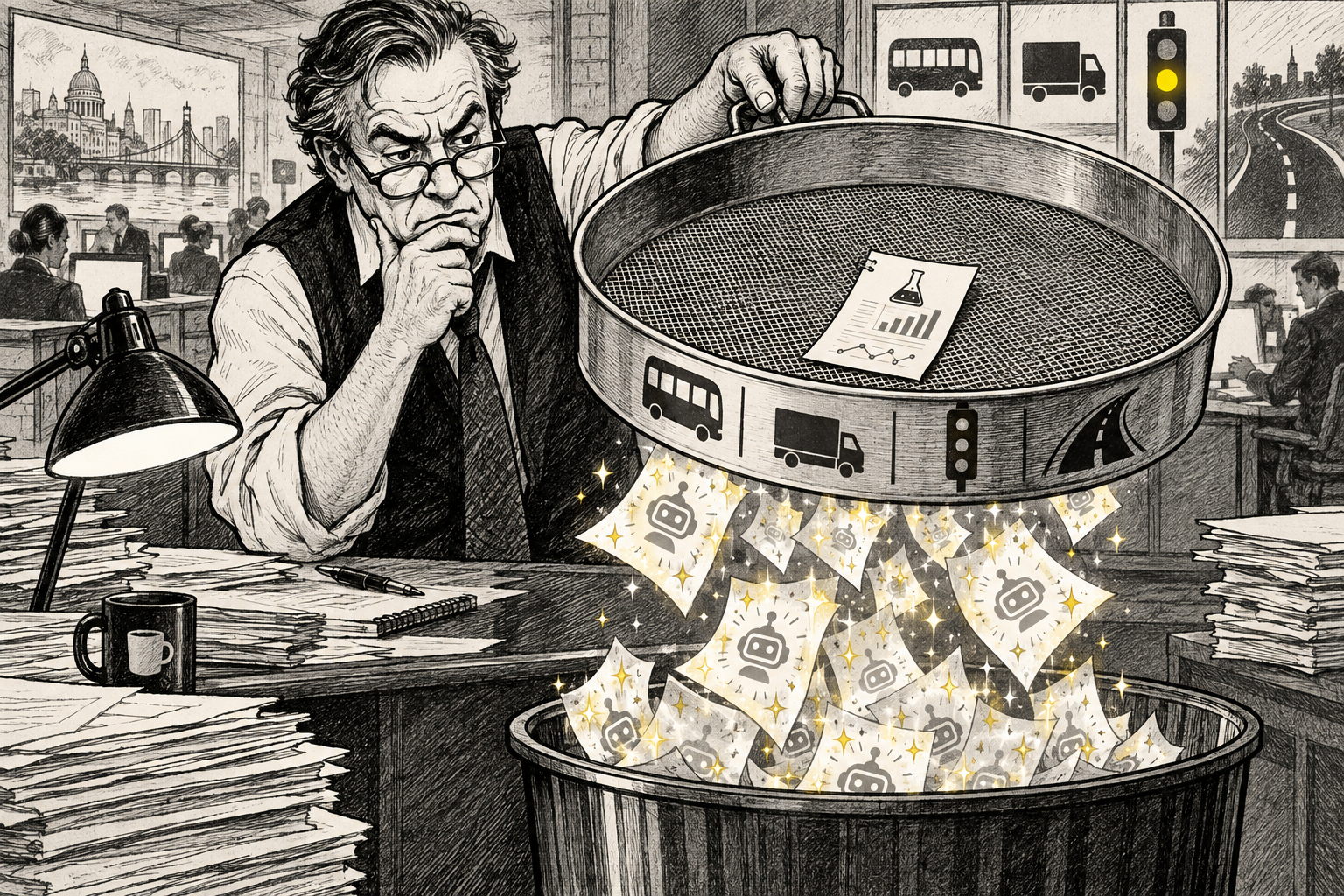
Friday arrived without a paper to crown. The feeds were busy; the evidence was not. In the 14–21 August screening window, this watch found no newly posted or meaningfully revised transportation-specific LLM study that met its bar for evaluation depth, safety relevance and direct transport contribution.
That sentence may look like an editorial failure. It is actually the most useful result of the week. A trustworthy watchlist needs a visible zero. Otherwise the pressure to publish a “top five” quietly converts weak demos, adjacent AI papers and corporate promises into research news.
What did not count
General agent-governance papers can be intellectually relevant, but relevance is not evidence of transportation performance. A carbon-pipeline optimization paper is transport in a physical sense but not passenger or freight mobility. A model that mentions an “autonomous” workflow is not automatically an autonomous-vehicle contribution. Those distinctions are unglamorous—and essential.
The missing experiments are now easier to name
The empty week highlights four absences. The screened material continues to make several gaps conspicuous: sustained field evaluations in public-transit control rooms are hard to find; energy and latency are rarely reported together for agentic routing or traffic management; cross-city robustness is discussed more often than it is demonstrated; and human operators are often weakly represented even when a system is meant to advise them during an incident.
This is a qualitative evidence map, not a bibliometric census. It records what was most visible in the material screened for this watch and should not be read as a statistical estimate of the field.
Why the blank week belongs in a systematic review
For an LLM4TR-oriented review, a zero-result week is still information about coverage. In this watch’s running corpus, information processing and driving decision facilitation are easier to find than deployment-focused knowledge encoding for transit agencies or logistics operators. Recording quiet weeks helps keep publication cadence from masquerading as balanced progress.
So this edition offers no “must-read” paper. Its must-read message is simpler: the field does not need another fluent prototype as much as it needs evidence from neglected modes, cities and operating conditions.
Beyond the papers: a quiet literature week, a busy deployment week
The paper pipeline was unusually quiet, but transportation AI itself was not. From 18–20 August, the International Conference on AI-Driven Transportation, Sensing and Automation convened in Xiangyang around autonomous driving, vehicle-infrastructure cooperation, traffic-flow optimization, multimodal perception and intelligent sensing. The conference agenda was almost a catalogue of the areas where transportation AI claims are expanding faster than shared evaluation practice.
On 20 August, Waymo also opened its Houston service to everyone through the Waymo app. That is a very different kind of evidence from a benchmark paper: repeated public operation, exposed to routine rider behaviour and urban variability. It does not answer every research question, but it changes the deployment baseline. The field now has to study not just whether autonomy can work, but how public-facing systems are monitored, updated and compared as they scale.
The same day, The Autonomous framed its upcoming Vienna event around a telling phrase: building trust for autonomy to scale. That wording captures the week's real story. The literature watch produced a visible zero; industry and policy conversations produced a visible demand for proof. The gap between those two is exactly where better research should go.
Sources & reading trail
- arXiv advanced search—weekly audit trail — searched through 21 Aug 2026
- AITSA 2026 — International Conference on AI-Driven Transportation, Sensing and Automation (18–20 Aug 2026)
- Waymo — Houston opened to all riders (20 Aug 2026)
- The Autonomous — Building trust for autonomy to scale (20 Aug 2026)
Reading note: This edition records a zero-result week under the watch’s stated screening criteria; it is not a claim that no transportation-AI paper of any kind appeared during the period.